
Documenta Madrid 2026 champions cinema as a direct record of reality in its 23rd edition
- Juan Cavestany closes the festival with the premiere of a film about Matadero Madrid as a symbolic space of urban and social transformation.
- The International Competition gathers films from 16 countries exploring the image as a space of conflict, memory, and representation.
- The National Competition offers a journey through new perspectives in Spanish cinema concerning territory, affect, identity, and forms of resistance.
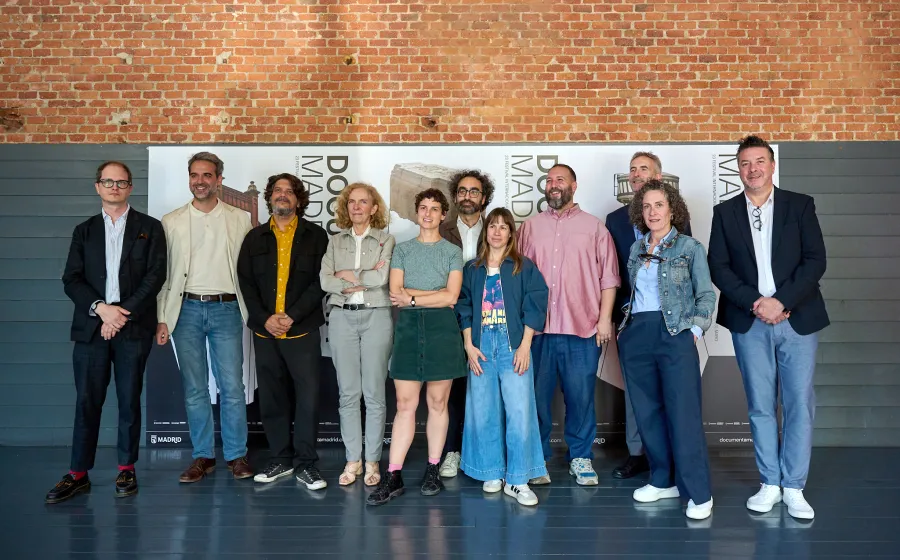
Cineteca Madrid has today presented the 23rd edition of Documenta Madrid, the International Film Festival organized by the Department of Culture, Tourism and Sport, to be held from May 26 to 31 at Cineteca Madrid and five other city venues: Filmoteca Española, the Reina Sofía National Museum and Art Center (MNCARS), La Casa Encendida, ECAM (School of Cinematography and the Audiovisual of the Community of Madrid), and the Goethe-Institut. Under the artistic direction of Luis E. Parés, the festival structures this year's program around the concept of 'Taking the Pulse'—a look at direct cinema that asserts its capacity to record contemporary reality without mediation, capturing its tensions, conflicts, and transformations in real time.
Unreleased Pasolini
The opening session will present Rivisitazione dello sciopero, an audiovisual experience based on the unfinished documentary Pier Paolo Pasolini dedicated to the first sanitation workers' strike in Italy in 1970. The original project materials—missing for decades—were recovered in 2005, although the soundtrack was lost forever. Starting from these silent images, artists Cosimo Terlizzi and Luca Maria Baldini have constructed a live performance that transforms the original material into a contemporary event.
Territory, affect, and political essay in the competitive sections
The competitive sections are structured into three categories: International Competition, National Competition, and Corte Final, dedicated to Spanish projects in an advanced stage of editing. Both the National and International Competitions grant jury and audience awards, and include the 'Fugas' award, which recognizes formal innovation and creative risk, distributing a total of 36,000 euros in prizes. Corte Final features a distribution award, granted by Agencia Freak and valued at 6,000 euros.
The International Competition brings together titles from 16 countries that approach the contemporary image as a field of dispute. In Afterlives (screening May 28), Kevin B. Lee investigates latent violence in the audiovisual ecosystem; As estações (May 27) by Maureen Fazendeiro intertwines oral memory and history in the Alentejo region; Debut, or, Objects of the Field of Debris as Currently Catalogued (May 29) by Julián Castronovo turns research into a digital archive; and El príncipe de Nanawa (May 30) by Clarisa Navas traverses the transition to adulthood in a border context between Argentina and Paraguay. From the perspective of the political essay, Evidence (May 29) by Lee Anne Schmitt reviews the structures of conservative thought in the U.S., while Far from Beyrouth (May 28) by Mon Dewulf constructs a visual correspondence marked by distance and war.
The section also includes works such as Lengua muerta (May 30) by Chilean director José Jiménez, focusing on the ineffable. Furthermore, May 27 will see the screening of Lloyd Wong, unfinished by Lesley Loksi Chan, which reflects on the heritage of images in queer memory in Canada; Nova ’78 by Rodrigo Areias and Aaron Brookner, which recovers the countercultural imaginary surrounding William Burroughs; and Perseidas by Natalia del Mar Kasik, which returns cinema to a primal experience. The selection is completed by Remake (May 29) by Ross McElwee, where the filmmaker reflects on how the compulsion to film has affected his life and that of those around him; two films with a post-colonial reflection, Sauf le passé (May 30) by Sanaz Azari and The Recce (May 28) by Daniel Mann; and the work on 2001 Gaza, With Hasan in Gaza (May 28) by Kamal Aljafari.
The National Competition offers works that explore territory, affect, and forms of resistance from personal perspectives. In Atlas de la desaparición (screening May 29), Manuel Correa accompanies search processes linked to historical memory; Crías (May 27) by Xiana Teixero activates an archive of female adolescent writing; and Después de las ciudades (May 28) by Xacio Baño constructs the city as a device of memory based on mediated images. Time and introspection run through El milagro (May 30) by David Varela, while Estados generales (May 29) by Mauricio Freyre explores the persistent traces of colonial violence.
From the sphere of care, Este cuerpo mío (May 27) by Afioco Gnecco and Carolina Yuste documents a gender transition process. Family memory and archive are intertwined in Fomos ficando sós (May 30) by Adrián Canoura, and sensory experience occupies the center in Krakatoa (May 28) by Carlos Casas. The section is completed by Like Moths to Light (May 28) by Gala Hernández López, which reflects on the exposure of the inner life in the technological age; No hay camino (May 29) by Luciana Espinoza Hoempler, which observes migration from a distance; OAO (May 27) by Rocío Mesa, which connects with primal emotions; and Perpetual Radiance (May 28) by Magdalena Orellana, which finds a core of beauty in urban fragmentation.
Corte Final gathers Spanish projects in an advanced stage of editing. In Escribir nuestro nombre y seguir (May 28), Fernando Vílchez and Lili Albornoz accompany women reconstructing memory marked by violence; Las termas (May 28) by Armin Marcheisini Weihmuler approaches old age with affection and fragility. Additionally, Memorias del exilio (May 27) by Manuel Correa explores the traces of political violence; and Río (May 27) by Chus Domínguez and Nilo Gallego Domínguez proposes an experience of strangeness between sound, landscape, and movement.
Parallel programming at five venues
In collaboration with Filmoteca Española, Documenta Madrid presents a retrospective dedicated to the Third World Newsreel collective, one of the most radical experiences of militant cinema that emerged in the U.S. between 1968 and 1972, using cinema as a tool to document social struggles. The cycle gathers key titles such as Columbia Revolt (1968) on May 27; The Woman’s Film (1971) on May 28; and El Pueblo se levanta (1971) and Break and Enter (1971) on May 29.
La Casa Encendida hosts the first retrospective in Spain of British filmmaker Charlie Shackleton, whose work occupies a hybrid territory between documentary, essay, and formal experimentation. The program includes Beyond Clueless (2014) on May 26; The Afterlight (2021) on May 27; and Zodiac Killer Project (2025) on May 29. Additionally, there will be a session of video essays on May 28 and a workshop with the author on May 27.
The Reina Sofía Museum presents a retrospective dedicated to Chilean filmmaker Marilú Mallet, a key figure of the first generation of female Chilean directors. Her work, marked by exile following the 1973 coup d'état, is articulated as an intimate exploration of memory, identity, and distance. The cycle includes four fundamental films, concluding on May 30 with a tribute to two other Chilean directors in exile: Valeria Sarmiento and Angelina Vázquez.
The ECAM Meeting, held across Cineteca Madrid, the Goethe-Institut, and ECAM, will be dedicated to German filmmaker Jan Soldat, whose work is characterized by a direct exploration of intimacy, bodies, and power dynamics. The program includes four retrospective sessions and a masterclass at ECAM on May 28.
Slovenia, Gabriel Veyre, and José Luis de Pablos
Parallel programming is completed by the cycle Una vanguardia recóndita. Cine experimental esloveno (May 29 and 31), curated in collaboration with the Slovenian Cinematheque. This is complemented by special sessions such as Las aventuras de un operador Lumière alrededor del mundo (May 26), featuring films shot by Gabriel Veyre, and the presentation of unreleased materials by operator and correspondent José Luis de Pablos (May 31), in collaboration with the ECAM Archive, which allows a revisiting of major 20th-century political and social events from a cinematic perspective.
‘Constelación Cineteca’ and Documenta Pro
‘Constelación Cineteca’ expands the festival, connecting cinema with research, mediation, and contemporary creation processes at Matadero Madrid. Through proposals such as ¿Descansa en paz? (May 28), Cuerpo Travesía (May 28), or Sombra larga (May 30), the program maps practices linking image, memory, and community.
Documenta Pro will take place on May 27 and 28, bringing together industry professionals to discuss the challenges of contemporary documentary film. Additionally, workshops such as Instrucciones para soñar una película colectiva (May 27–29) and Con las manos en la imagen (May 30–31) invite participants to explore cinema from a participatory and experimental perspective.
Closing by Juan Cavestany
The festival will close on May 31 with the premiere of Vial Matadero, an unreleased film by filmmaker Juan Cavestany, produced by Matadero Madrid and Cineteca Madrid. The film proposes a look at Matadero as a symbolic space of urban and social transformation.
More information: documentamadrid.com