
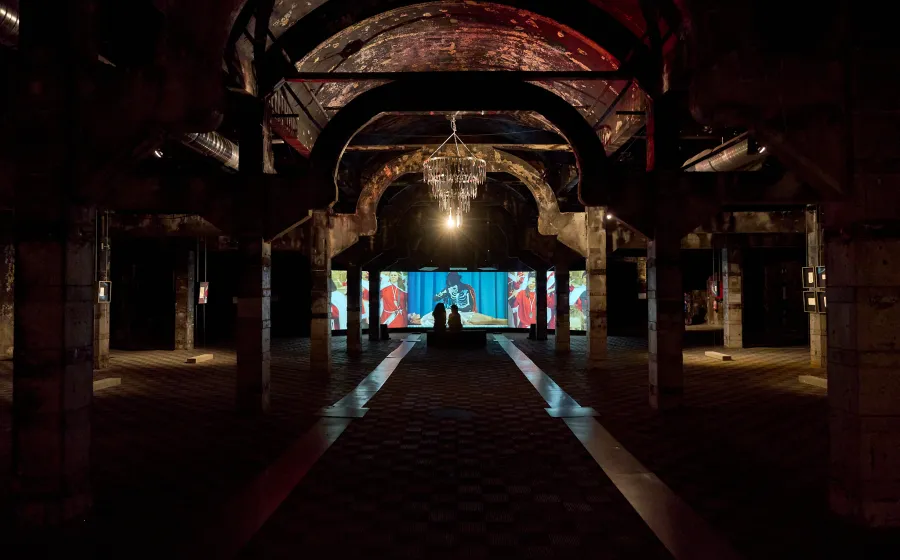
Visual artist Greta Alfaro intervenes in Nave 0 at Matadero Madrid with the site-specific exhibition 'Ofertorio'
- The exhibition reflects on how contemporary culture constructs what we choose to show and what we prefer to keep out of sight.
- Conceived specifically for Nave 0, the installation transforms the space into a journey crossed by references to ritual, anatomy, and body representation.
- As part of the PHotoESPAÑA 2026 program, this marks Greta Alfaro’s first solo exhibition in Madrid.
- The 'Abierto x Obras' program invites contemporary artists to explore the relationship between art and the spaces that host it with new, site-specific works.
Matadero Madrid, the contemporary creation center of the Department of Culture, Tourism and Sport, continues its 'Abierto x Obras' program with the exhibition Ofertorio by visual artist Greta Alfaro. For this intervention—her first solo show in Madrid—the Navarrese creator has conceived videos specifically designed for the cold storage room of the former municipal slaughterhouse. Her powerful images, infused with irony and transcendence, probe the idea of sacrifice and that which remains hidden from view.
Ofertorio takes its title from an ancient gesture: to offer. To place something before others, to expose it to the light, and to turn it—if only for an instant—into something shared. In ritual traditions, the offertory marked the moment when specific objects or food left the private sphere to enter a collective and symbolic dimension. Something was delivered, displayed, and laid out before the community. The exhibition is situated precisely in that intermediate territory where matter ceases to belong only to itself and begins to form part of a system of representation.
In this proposal curated by María Pallás, who served on the PHotoESPAÑA steering team for nearly a decade, Greta Alfaro will transform the space into a kind of temple. The central nave leads toward a head section conceived as a visual focal point where her videos are exhibited, while the side pieces function as small stops along the path. The spectator moves through the space following a logic akin to that of a ritual. The aim is not to reconstruct a lost liturgy, but to observe how certain forms of symbolic organization continue to operate under different rules.
Beyond the imposing videos created by Alfaro, the exhibition is completed with other objects such as sculptures, photographic collages, and an 18th-century anatomical torso (historically used for the study of anatomy), which belongs to the collections of the Javier Puerta Museum of Anatomy, part of the Historical-Artistic Heritage of the Complutense University of Madrid.
Ofertorio is part of the PHotoESPAÑA 2026 program, which, under the title 'Volver a imaginar' (Re-imagining), focuses on experimentation and the boundaries of photography.
Greta Alfaro: An illustrious international career
Greta Alfaro (Pamplona, 1977) is one of the most important visual artists of her generation in Spain and one with a significant international presence. Notably, she was the first artist to sell her work to the prestigious Saatchi Gallery in London.
Her artistic practice is developed through video, photography, installation, and collage. Her work, with its strong symbolic and theatrical character, explores the tensions between beauty and destruction, celebration and decay, nature and artifice, constructing images of great visual power that refer both to the Baroque tradition and vanitas as well as to contemporary issues.
A graduate in Fine Arts from the Polytechnic University of Valencia with an MA in Fine Arts from the Royal College of Art in London, Alfaro has developed an international career marked by visual narratives where the uncanny erupts into everyday settings. Her work dialogues with imaginaries derived from art history, ritual, myth, and popular culture, frequently using animal presence and theatricality as tools for critical reflection on contemporary society.
Free public activations
During the month of June, Ofertorio will be expanded through two public activations conceived by Greta Alfaro specifically for the exhibition. These proposals will bring some of the characters, sounds, and references present in the works into the space of Nave 0, offering new ways to approach the project. The activations will culminate in guided tours by the artist herself, generating a space for meeting and dialogue around the processes, symbols, and imaginaries that articulate the exhibition.
Reactivation of 'Abierto x Obras'
In its previous phase, between 2007 and 2018, the 'Abierto x Obras' program offered the Madrid public unique interventions by artists such as Daniel Canogar, Jannis Kounellis, Roman Signer, Eugenio Ampudia, Carlos Garaicoa, Fernando Sánchez Castillo, Jordi Colomer, Los Carpinteros, Cristina Lucas, Cabello/Carceller, Elena Alonso, and Teresa Solar, among others.
In this new stage, 'Abierto x Obras' maintains its essence, inviting artists to create a new piece expressly conceived for a specific space, exploring the relationship between art and the spaces that host it, in a clear commitment to the promotion of contemporary artistic practices that seek an interrelation with their place of development.
Greta Alfaro is the first visual artist to participate in this new stage following a cycle focused on contemporary sculpture featuring Eva Fábregas, Cristina Mejías, and Mónica Mays. Notably, Mejías received the 2026 Ojo Crítico award in the visual arts category for her installation in 'Abierto x Obras'.
Carlos Aires takes over in September
The fifth exhibition of the cycle will be led by artist Carlos Aires (Ronda, 1974), curated by José Luis Romo, artistic director of Matadero Madrid. In his intervention, which will condense several features of his artistic practice, Aires weaves together the euphoria of dance and the scent of apocalypse that surrounds these times.
Aires has received numerous recognitions throughout his career. He has been awarded prestigious grants and prizes, including: OMI Residency (USA), Edith Fergus Gilmore Prize (USA), Generación 2008 Caja Madrid (Spain), Young Belgian Art Prize (Belgium), I Young Andalusian Artists Prize (Spain), Fulbright (USA), Walter Debrock Prize (Belgium), Manuel Rivera Grant (Spain), and De Pont Atelier (Netherlands).