
Ana Robles Pérez
Villalba tiene memoria de perro (Villalba has the Memory of a Dog)
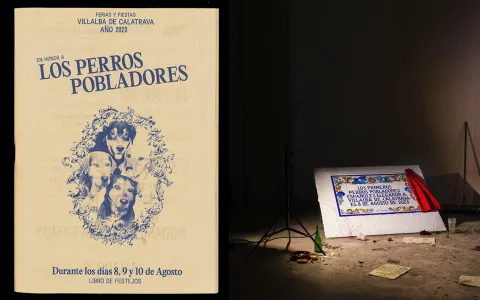
The focal point of this project is Villalba de Calatrava, a historic settlement village currently home to barely five residents. In 2023, the village hosted the universe of the artist’s earlier project, La llegada del perro poblador (The Arrival of the Settler Dog), in which dogs rendered invisible by adoption systems became inhabitants of rural territories at risk of depopulation, configuring new modes of occupation and interspecies coexistence. The artist now returns to this same setting to imagine a future where generations of settler dogs have occupied—and continue to occupy—its streets. Drawing inspiration from Jennifer Wenzel’s concept of ‘past's futures, future's pasts’, the project is set three decades ago, when its streets were inhabited by Yeska and Mori, dogs enshrined in the village’s collective memory. Through testimonies, archives, and forensic-visual methodologies, the artist constructs an audiovisual cartography exploring how the village has generated—and will continue to generate—its memory. A memory arising from human absence. A memory yet to happen. A dog’s memory.
Bio
Ana Robles Pérez (Ciudad Real, 1997) studied Social Design at the Design Academy Eindhoven and is a member of several research groups alongside teams from the Universities of Utrecht and Amsterdam. She has exhibited at the 17th Spanish Architecture and Urbanism Biennial (Ponferrada), the Ars Electronica Festival (Linz), the 19th Venice Architecture Biennial, and CentroCentro (Madrid), among other venues. Her practice draws on imagination and speculation as tools with which to explore alternative ways of understanding memory and heritage. From a more-than-human perspective, she develops visual forensic methodologies, cartographic atlases, and documentary works that bring subaltern memories tied to processes of social transformation to light, opening up space for other ways of narrating and remembering.