
Because of Who They Were, We Are

Reduced mobility

Amplified sound
Date
Venue
Price
Free admission until full capacity is reached
Category
Institution
Programme
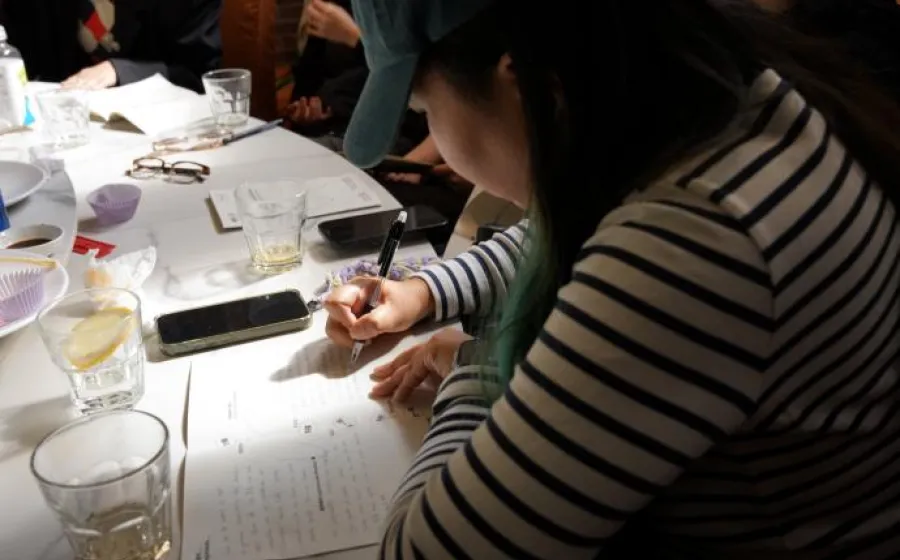
Closing event of the project Where is my friends______? and presentation of the photobook dummy resulting from a research process on the memories and archives of the Chinese community. Through a conversation with interviewees and project participants, an open space will be created to share stories and experiences, and to continue building a living archive that connects territories, generations, and ways of inhabiting space, both within and beyond Usera.
Participants
- Yuan iuan is a Chinese migrant, anti-racist queer activist, and visual artist specializing in spatial design. Their practice sits at the intersection of art, memory, and social justice, with a focus on migrant experiences, territory building, and the creation of spaces of community resistance. In their projects, they combine photography, writing, oral archives, and editorial design to activate collective memory processes and challenge hegemonic imaginaries surrounding Chinese people in Spain. Yuan iuan has been a member of the 8M Madrid Anti-Racist Commission, participates in organizing spaces for the Asian diaspora in the Spanish State, and is active in the Chinese diaspora queer collective (Queering All). They have worked on projects concerning migrant memory and cultural identity as a form of resistance, including an artistic research project on diaspora belongings and an upcoming book on everyday practices in safe spaces in neighbourhoods such as Usera.
Eva Chen was born in Madrid into a family of Chinese origin. She grew up between two cultures that have shaped her family history and influenced how she relates to identity, memory, and community. Eva’s family history is closely tied to the history of Chinese restaurants in Spain. According to family accounts, her grandfather 陈迪光 was a pioneer in the field, connected to the restaurant La Gran Muralla (长城). Gastronomy appears not only as an economic activity, but also as a space for transmitting knowledge, relationships, and memory within the Chinese community. This family memory intersects with another cultural history: her family’s presence in the theatre world during the second half of the 20th century, linked to the renowned Teatro Chino de Manolita Chen. According to family tradition, her great-grandfather, Chen Tse Ping, was a founder of this project.
The name Manolita Chen, later reclaimed by Eva in one of her culinary projects, serves as a way for her to recover a portion of this family and cultural memory that she considers erased or stripped of its origins. Beyond being Eva Chen’s family story, this is also the story of the construction of the Chinese diaspora in Spain—it is everyone’s memory. Today, Eva continues to engage with these narratives through gastronomy. In addition to Manolita Chen, she is the founder of La Pagoda, two restaurant projects in Madrid through which she explores Asian gastronomy from a contemporary perspective, deeply rooted in her family memory and origins.
Her experience forms part of the story of a generation born or raised in Spain within Chinese migrant families: a generation brought up between different cultural references that constructs its own ways of inhabiting, transmitting, and reinterpreting that heritage. In Eva’s case, this relationship with identity is especially linked to food, names, restaurants, family histories, and the reclamation of a cultural memory that continues to evolve in Madrid.
Shishi Zhu (Wenzhou, China, 1995) is a transdisciplinary artist, performer, and mediator. Her artistic practice explores the cultural and artistic languages of East and West, with a special focus on dialogic and performative creation, cultural landscapes, and the relationship between the collective and the individual. Through her work, she addresses socio-community and intercultural issues, generating spaces for dialogue, gathering, and mutual understanding. As a member of the Cangrejo Pro collective, she uses performance to explore collective identity and community experiences. In her solo practice, she develops primarily visual and pictorial research, incorporating different cultural languages and reflecting on artistic and lived experience.
Memory, experience, and shared stories are fundamental elements of her practice, bridging artistic creation and creative writing.
Within the framework of Where is my friends_____?, Shishi Zhu has served as facilitator and participant in the "Sensory Mapping in Usera" activity, and as a collaborator in the intergenerational encounter held with the Senior Centre of the Chinese community in Usera. Her participation has helped create spaces for gathering, exchange, and collective reflection around the memories and experiences of Usera’s Chinese community.
Xiaoya Chen, former resident of the Usera neighbourhood and 同工 (collaborator) at the Chinese Evangelical Church of Madrid. She arrived in Madrid on October 4, 1991, and from her early years in the city, began seeking gathering spaces linked to the Chinese Christian community. In 1993, she opened a clothing factory and started a small house church, which over time grew into one of the key gathering points for Madrid’s Chinese Christian community. Together with her partner and three daughters, she participated for decades in the daily life of these spaces: meetings in private homes, celebrations, Sunday school where she taught, family gatherings, and community activities, supporting the transmission of language, cultural practices, and Christian faith.
Her testimony also highlights the material dimension supporting these spaces, in which she contributed through searching for and acquiring premises, funding, and management. Her experience is closely tied to work in the textile industry; she managed a factory of approximately 300 m² with over twenty workers on Calle Nicolás Godoy.
Far from being just an individual journey, her story offers insight into a network of relationships built around the church: families coming together, people collaborating, children growing up together, people sharing food and work, and a community building and sustaining its own gathering spaces.
- Emily Sun is an artist working across music production, cultural mediation, and curation. Her practice explores sound and music as modes of healing and constructing diasporic memory, activating collective creation as a channel of resistance.
Project selected under the “Intermediae Distribuido 2025-2026” open call, aimed at community and participatory proposals across the districts of Arganzuela and Usera.