
Estudio de Sistemas (Systems Analysis). Marina Otero y Manuel Correa
Date
Venue
Institution
Programme
Estudio de Sistemas (Systems Analysis) is a new program from Medialab that addresses the functioning of complex technological infrastructures and their material, social, and cultural effects from diverse perspectives.
In this series of activities, we observe technology not so much as a device or infrastructure, but as a phenomenon of scale. Our goal is to learn about specific methods, practices, and experiences that shed light on processes that exceed human perception due to their speed, their level of abstraction, the time frames they span, or the technical opacity that surrounds them.
Estudio de Sistemas is designed to be a precise and urgent learning opportunity outside of academia, thanks to firsthand accounts from relevant figures in contemporary art and research. In this final chapter of the series, we welcome Marina Otero Verzier, architect and researcher specializing in digital infrastructures, data ecologies and new aesthetics of storage, and Manuel Correa, Colombian artist and filmmaker whose work explores memory and post-conflict reconstruction, to share their work in an Open Studio featuring their two most recent projects:
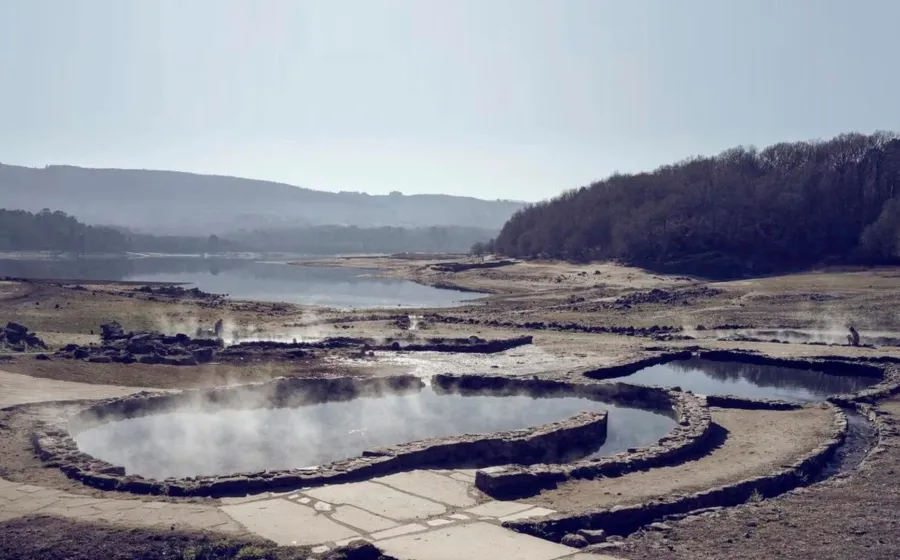
I Spoke with a Spring, Let Me Tell You Its Story
Marina Otero
I Spoke with a Spring, Let Me Tell You Its Story is a video installation about the future of thermal waters in southern Galicia and northern Portugal, a region caught between lithium extraction and the preservation of an ancestral ecosystem. This cross-border territory is known for its mineral-medicinal waters, rich in lithium, which are integral to the daily lives of its inhabitants, who consider them healing and visit springs and washhouses to drink, bathe, or collect the water for domestic use. At the same time, the region is presented as one of Europe’s largest lithium reserves—a key element in the production of batteries for electric cars, mobile phones, computers and renewable-energy infrastructures—and has been declared strategic for the so-called green transition and the continent’s energy autonomy. The future of these communities is suspended between two models: one driven by the urgency of decarbonization, the other guided by the desire to preserve the life that has flowed from these springs for centuries. The work gathers the stories, tensions and affects surrounding lithium and the different energy cultures that converge—and collide—throughout this territory.
What Happened Next?
Manuel Correa
Judge Martha Lucía González uncovered the dark networks binding together the military, paramilitaries, drug traffickers and landowners in Colombia, challenging figures such as Pablo Escobar and high-ranking army officers. After three decades in exile, I managed to find her: she asked me to tell her story for the first time.
In What Happened Next?, the judge becomes a witness. I will work with four performers to recreate the violent events she experienced.
Inspired by forensic criminology techniques, I will film these reenactments while Martha Lucía’s voice-over guides them. I seek to offer a testimony that resembles the presentation of evidence before a court. The reenactments aim to generate an embodied understanding of the facts: the video becomes an investigative tool. Legal rituals of truth-making focus on visible evidence, but often overlook silence. It is frequently in the gaps and failures of memory that trauma is inscribed. The imperfections of testimony—the impossibility of speaking or remembering—are themselves marks of violence. For this reason, the aim of this research is not to break silence, but to interrogate it in its full magnitude.
Location: Nave Una, Medialab Matadero
Time: 19:00–21:00 h
Language: Spanish
Free admission until full capacity is reached
Projects funded by Ayuntamiento de Madrid.