
SUMMER CAMP IN MADRID
Ages: 6 to 12 years old.
Date
Venue
Price
- 1 week: €125
- 2 weeks: €220
- 3 weeks: €330
- 4 weeks: €440
Category
Format
Institution
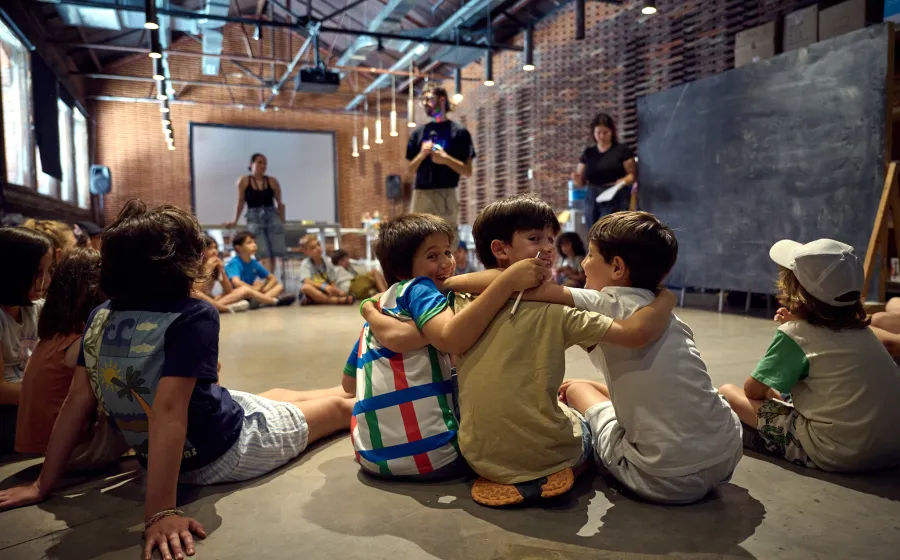
Creative Detour (Desvío creativo) is an art camp that invites children to explore new ways of imagining, building, and communicating through contemporary art. For four weeks, Matadero Madrid will be transformed into a large-scale experimentation workshop where we will investigate key elements of the creative process: materials, ideas, the body, and space.
Through activities inspired by contemporary artistic practices, participants will examine their daily surroundings to transform them into creative projects. The camp offers a journey through different forms of artistic creation, combining material experimentation, visual thinking, physical expression, and spatial interventions.
Weekly Program
The camp is organized by the week, from June 22 to July 17. Activities take place from 9:00 AM to 2:30 PM, with extended drop-off from 8:30 AM and pick-up until 3:00 PM.
- June 22 – 26 · Matter (Materia) We begin by exploring materials from a sensory and experimental perspective. Through play and direct handling, we will discover how different materials—from wood and natural pigments to contemporary media—can convey ideas, emotions, or movement.
- June 29 – July 3 · Idea This week focuses on the origin of ideas and the development of artistic projects. Using observation exercises and mapping the Matadero environment, participants will draft their own proposals, materialized through sketches, scale models, and collective projects.
- July 6 – 10 · Body (Cuerpo) The body becomes a tool for artistic expression. Through dynamics linked to live arts (artes vivas), we will experiment with movement, action, and gesture to communicate. We will also explore self-portraiture through unconventional lenses, using masks, characters, and silhouettes.
- July 13 – 17 · Space (Espacio) In the final week, we investigate how art can transform our surroundings. We will work with installations, ephemeral architecture, and other forms of intervention to create structures, shelters, and meeting points, turning the site into a territory for collective exploration.
Key Information
- Target Audience: Curious children aged 6 to 12. Participants must be within this age range at the time of the camp.
- Groups: Two groups of 15 participants maximum, with two educators per group. Groups are organized by age and affinity.
Frequently Asked Questions (FAQ)
- Is lunch provided? No, but there is a mid-morning break for a snack brought from home. Children staying for the extended pick-up (until 3:00 PM) may also bring a small snack.
- What should they bring for lunch? Please note that we do not have cold storage. Food should be brought in an appropriate, insulated container.
- Are there outdoor activities? Yes, some activities take place in shaded outdoor areas of the Center. Additionally, some sessions include walks to nearby areas such as Madrid Río Park, always accompanied by the education team.
- Can adults visit the activities? Every Friday during the final hour, families are invited into the classrooms to see the work created during the week.
- How do I register? First, purchase a ticket for your chosen week(s) via the Matadero Madrid website. Once purchased, you will receive a registration form to provide the participant's details.
For more information, contact: educacion@mataderomadrid.org
About the Organizers
Creative Detour is designed and led by Asociación Betamind. Founded in 2017, Betamind is a collective that investigates creative processes through wonder, experimentation, and play. Comprising multidisciplinary artists with backgrounds in teaching, research, design, and psychology, their work sits at the intersection of art, science, and nature.
Their projects are developed from a critical pedagogy perspective, encouraging direct exploration and supporting the innate curiosity of children. They have collaborated with institutions such as the Museum of Children's Art (MuPAI) and Espacio Abierto Quinta de los Molinos.