
What Cannot Be Spoken About, Better Ask a Ghost

Reduced mobility

Amplified sound
Project selected under the “Intermediae Distribuido 2025-2026” open call, aimed at community and participatory proposals across the districts of Arganzuela and Usera.
Date
Venue
Price
Free admission until full capacity is reached
Category
Institution
Programme
The Night of the Dead, All Hallows' Eve, Halloween Eve… On October 31, we gather to conclude the project Culturas del duelo al sur de Madrid (Cultures of Grief in Southern Madrid) by Inés Plasencia Camps, part of the Intermediae Distribuido programme. It will be a day dedicated to discussing grief as a process that generates culture, art, memory, languages, and belonging along its way. A process shaped by material and political conditions that profoundly affect how we die and grieve, but also by the possibilities that open up when thinking from its heterogeneity and the forms of memory that have brought it to where it is today.
Programme
- Part One (5:00 PM – 7:00 PM)
- Layla Martínez, Lloronas y vestidoras. Viudez y trabajos de la muerte (Mourners and Shrouders: Widowhood and the Labour of Death).
- Noelia Cortés, Espejos entre el luto victoriano y la literatura flamenca (Mirrors Between Victorian Mourning and Flamenco Literature).
- Pablo Zamorano, Mover lo invisible. Prácticas artísticas, curatoriales y de investigación en torno a la mediumnidad, las ancestralidades y las relaciones entre vivos y muertos (Moving the Invisible: Artistic, Curatorial, and Research Practices Surrounding Mediumship, Ancestry, and Relationships Between the Living and the Dead). In collaboration with the ИOBIEИBRE project (Transdisciplinary Encounters on Death).
- Interlude (7:15 PM – 7:45 PM)
- Inés Plasencia Camps, Demolición parcial de zonas desprendidas. Lenguaje administrativo y duelo en la ciudad (Partial Demolition of Detached Areas: Administrative Language and Grief in the City).
- Part Two & Closing (8:00 PM – 9:00 PM)
- Presentation of the zine Quién lleva de la mano a unx muertx (Who Holds a Dead Person's Hand), the result of the Gabinete efímero de escritura funeraria (Ephemeral Funeral Writing Cabinet), published by Las Lindas Pobres (Mágui Dávila).
Asociación Samahang Kayumanggi, Atang. Una mesa para las que (no) están (Atang: A Table for Those Who Are [Not] Here).
To accompany the presentation and release of the zine, the proposal combines three languages into a single session: a conceptual presentation by the research team from the Asociación Samahang Kayumanggi, a live poetic activation, and a ritual offering setup constructed alongside the participants in the zine's creation process and anyone wishing to join. The project closing incorporates an Ilocano practice of offering food to the dead—the atang—to reflect, from the perspective of the Philippine diaspora in Madrid, on how absence is remembered, accompanied, and shared.
The session concludes with a gesture of shared joy—karaoke—reclaiming the idea that accompanying death does not always have to be done through sadness alone.
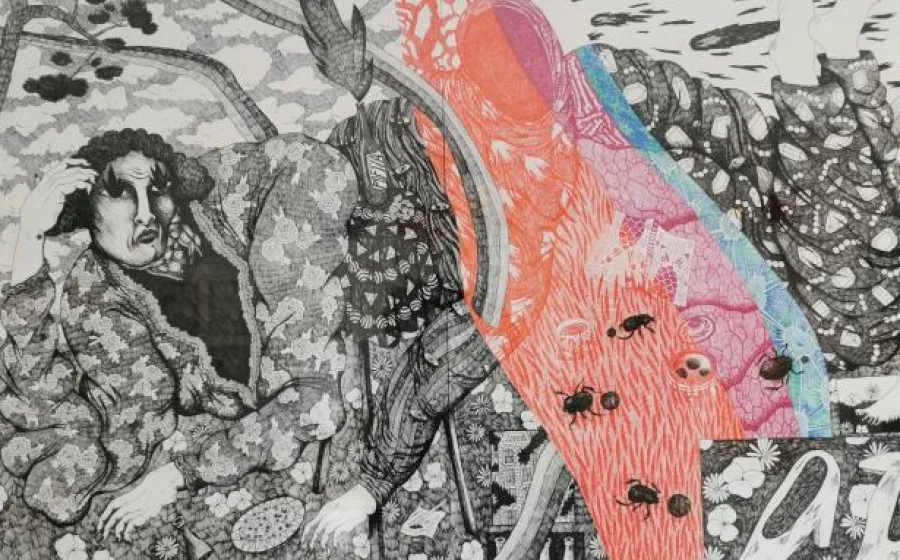
Visual Intervention by Coco Guzmán
Domingos en el Parque (Postales para el Fin del Mundo) [Sundays in the Park (Postcards for the End of the World)], 2026. Marker on paper, 75 × 100 cm.
This drawing belongs to a series (Postcards for the End of the World) that explores ends of the world not as a single event, but as all those instances in which the world as we know it comes to an end: colonisation, genocide, species extinction, crises such as HIV/AIDS, as well as irreplaceable individual losses such as the death of friends, family members, or lovers. This work reflects the experience of survival in an environment marked by too much death and of continuing with life—going to the park, for instance—after losing people who were very close. It is a Sunday outing to the park surrounded by ghosts, books, ownerless shoes, and bottles you drink from alone, which at times provide the necessary company. In the background, the world keeps burning.
Biographies & Contributors
- Layla Martínez is an editor and writer. She has published the essay Utopía no es una isla (Episkaia, 2020) and the novel Carcoma (Amor de Madre, 2021), translated into nineteen languages, adapted for the stage in four countries, and currently being adapted for film. Carcoma received the Ignotus Award for Best Novella and the Festival 42 Award for Best New Novel, and was nominated for the National Book Award in the United States. Layla has taught workshops on speculative fiction, the history of horror, and female archetypes in cinema. She is currently working on her second essay and her second novel.
- Noelia Cortés (Almería, 1996) is the author of the poetry collections Del mar y la muerte and Rosal o reptil, and the feminist essay La higuera de las gitanas. Through her literary and social research on flamenco (cante gitano andaluz), she has developed a perspective that connects this universe with the imaginaries of other cultural movements, such as Pre-Raphaelitism or English Romanticism.
- Pablo Zamorano Azocar (1987) is a Chilean artist, researcher, and performer based in Madrid. His practice in live arts articulates body, spirituality, and thought, exploring the invisible and intangible through various material media. He holds a BA in Dance Arts from the Universidad de Chile, an MA in Performing Arts Practice and Visual Culture (Museo Reina Sofía–UCLM–Artea), and an MA in Art Research and Creation from the Universidad Complutense de Madrid (UCM), where he is currently pursuing a PhD in Fine Arts. He is the curator of NOVIENBRE: Transdisciplinary Encounter on Death. He has developed live arts creation projects across Europe, Mexico, and Latin America at venues including C3A Córdoba, TBA21–Museo Thyssen-Bornemisza, Museo de América in Madrid, Teatro Pradillo, Röda Sten Konsthall, and the Museo Nacional de Bellas Artes de Chile, among others.
- Samahang Kayumanggi is an association and artistic collective dedicated to strengthening community bonds among various actors within the Philippine diaspora. Founded as an organic space for gathering and mediation, the group focuses on building intercultural bridges and claiming the plurality of Pinoy identities. Through its collective practice, Samahang Kayumanggi promotes an active, critical, and contemporary dialogue, placing the voice, culture, and experience of the Filipino community at the centre of the social and cultural ecosystem. Formed by Don Jovan Urbiztondo, Karessa Malaya Ramos, Lourdes Veluz Bernardo, and Sheryl Sénica.
- Las Lindas Pobres is an independent publishing house created by Magui Dávila, dedicated to producing beautiful editions with limited resources—or with whichever resources are available. LLP has evolved into a research space reflecting through its publications on electronic music and popular culture, bringing visibility to practical knowledge developed on dance floors, in rehearsal rooms, on album covers, and within internet communities as forms of artistic action and production. Across its past and upcoming publications, it addresses socio-political issues, gender, biopolitics, and more (www.maguidavila.com).
- Coco Guzmán (Coco Riot) is a trans and queer visual artist, researcher, and educator currently based in Madrid. Their artistic practice, centred on drawing and site-specific public practices, explores the relationships between gender, identity, memory, territory, and resistance, with a particular focus on the experiences and knowledge production of trans* and queer communities. They hold a PhD in Artistic Research and Production from the Universitat Politècnica de València (2024), an MA in Interdisciplinary Art, Media and Design from OCAD University (Toronto), and degrees in Comparative Literature (Université Paris 8) and Fine Arts (École Supérieure des Beaux-Arts de Toulouse). Their international trajectory includes exhibitions and projects at Onsite Gallery (Toronto), CHEAP (Bologna), the Havana Biennial, Hemispheric Encounters (Mexico City), La Centrale (Montreal), CentroCentro (Madrid), Intermediae Matadero Madrid, The Bentway (Toronto), and The High Line (New York). Since 2025, they teach at NYU Madrid, offering courses linking artistic practices, activism, research, and visual culture.
- Inés Plasencia Camps is a researcher, educator, and writer. She is currently focused on grief and researching/writing about fear and the boundaries of reality and fiction when processing death. She is interested in curating public programmes for their potential to create temporary spaces of intimacy, and writes in search of a language to comprehend and remember.
- Zine Contributors: Víctor Mora Gaspar, Carmen Lozano Bright, Sandra Cendal, Olga LLP, Trixy, Carmen Haro, Inés Plasencia Camps, Ana Castro Valero, Berna Wang, Jessica Janeiro Obernyer, Magui Dávila, Flor M. Yustas, and Rosa Casado.
Project selected under the “Intermediae Distribuido 2025-2026” open call, aimed at community and participatory proposals across the districts of Arganzuela and Usera.