
Matadero Madrid hosts the group exhibition 'The Mechanics of Truth' as part of Medialab’s LAB 5
- The four proposals in this exhibition form a group showcase featuring unreleased, site-specific works by six international artists
- The exhibition is part of the collaborative research laboratory LAB 5: The Mechanics of Truth, currently developed by the Medialab Matadero program
- Key activities proposed by LAB 5 include the Estudio de Sistemas creative training and research program, a Collaborative Prototyping Laboratory, and the OpenLAB festival
Madrid, [Date] – Matadero Madrid, the contemporary creation center of the Department of Culture, Tourism and Sport, will host the group exhibition The Mechanics of Truth (La mecánica de la verdad). The exhibition explores the research that a new generation of artists—highly familiar with digital technologies—is conducting not only on "truth," but also on its "mechanics." The proposal, on display in Nave Una from October 15 to December 13, is part of LAB 5: The Mechanics of Truth, a multidisciplinary program by Medialab Matadero.
Through a combination of unreleased works and site-specific installations, the exhibition confronts the public with the techno-cultural mechanisms that are redefining what we used to call "the real." The artists conjure up digital stories and artifacts—some found, others created expressly for the show—that remind us that no technical system is innocent and that approaching the truth must be a collective, hybrid effort.
Exhibition Itinerary
Video Installation: AI Hyperrealism (2024)
By Martyna Marciniak [Polish artist, researcher, and 3D designer exploring visual storytelling through animation, film, writing, and digital model-making]
AI Hyperrealism is the first chapter of Anatomy of Non-Fact, Martyna Marciniak's project on the aesthetics of visual misinformation in the era of synthetic images. It takes as its starting point the "Balenciaga Pope," the artificial intelligence-generated image showing Pope Francis in a white puffer jacket that went viral in 2023.
The installation brings that image into physical space; its centerpiece is the coat, tailored as a real garment that reproduces in its fabric the flaws and impossibilities of the original image so they can be examined up close. The lining features embroidered references to the history of visual truth, from the Baroque period to AI-generated imagery. It is accompanied by three small sculptural pieces and a 16-minute video in which the "Balenciaga Pope," played by actor Derrick Jenkins, delivers a monologue on the crisis of trust in images and in the authorities that certify truth. The text incorporates a lexicon of neologisms created by the artist to name these new visual phenomena.
The work received an Award of Distinction at the Prix Ars Electronica.
Generative Cinema Installation: Oracle Index (2026)
By latency.club [an evolving collaborative platform initiated by Nestor Siré and Steffen Köhn, operating between Havana, Berlin, and other contexts]
Oracle Index is a generative cinema installation that imagines a future Cuba where, following a total embargo, the State adopts cryptocurrencies and prediction markets to attract foreign capital. Excluded from this system, the population creates its own betting economies, mixing official data with La Bolita, the underground numbers lottery, while santería incorporates artificial intelligence into divination.
The narrative is presented as a fragmented archive compiled by an anonymous anthropologist: interviews, field notes, state television broadcasts, social media snippets, and the dreams of La Bolita players recreated using obsolete generative AI models. The scenes are performed by real people whom the artists met during their fieldwork in Cuba.
The videos are displayed on a large LED screen connected to four cryptocurrency mining rigs, each holding a portion of the archive. The machines compete in a cryptographic lottery—the same process that secures Bitcoin—and the winner sends its next video to the screen: the order of the narrative is determined by chance. These are second-hand units, retired when Ethereum stopped using this type of mining in 2022.
Co-produced by Medialab Matadero, this newly minted work is an international premiere.
Documentary Installation: Terror Element (2025)
By Anna Engelhardt [video artist and writer working with video installations, computer-generated animation, and archival research] and Mark Cinkevich [researcher and artist exploring how infrastructures and visual technologies organize power]
Terror Element is a hybrid documentary set in a modern forensic laboratory. Nina, a forensic expert, finds a videotape about the apartment building bombings that shook Russia in 1999 and were used to justify the second invasion of Chechnya. Using digital reconstructions and archival footage, the film follows her investigation; as she reviews the images, her own laboratory begins to resemble the one on television. The film examines how forensic science imagery is used to project state power.
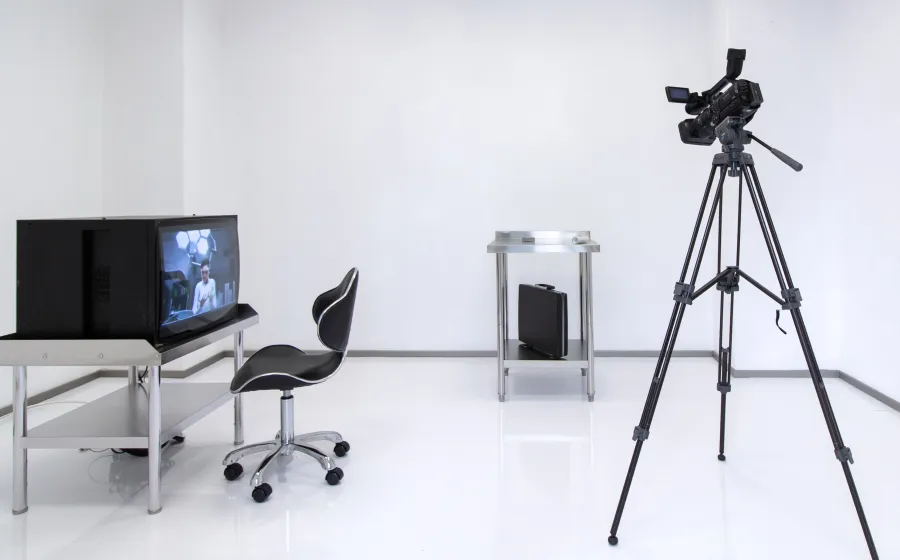
The installation reconstructs the film's digital setting within the gallery using three elements. The film is viewed on a tube television almost identical to the one used by the protagonist. Next to it is a laboratory set complete with vials, a metal tray, and an explosives detector spray—the exact model used in the 1999 investigation, identified by the artists during their research and still in use today. A video camera records the set in real time, allowing visitors to compare the physical set design with the image produced by the camera on its small screen.
Unreleased in Spain, the work was exhibited at Rudolfinum (Prague) and will travel to Gasworks (London) in 2027.
Audiovisual Installation: Unpredictable Atmosphere (2025)
By Lucia Rebolino [research-oriented artist, architect, and computational designer, currently a researcher at Forensic Architecture in London]
Unpredictable Atmosphere is an audiovisual installation that uses the web as an optical device to display real-time climate models. It stems from a specific problem: AI-based climate models tend to overlook extreme phenomena, such as hurricanes, because they are trained to reproduce what is statistically regular.
Developed with specialists in fluid dynamics and climate science, the work recombines data from past hurricanes—precisely those that eluded accurate prediction—to generate a continuously varying synthetic atmosphere. The simulation is organized into four layers corresponding to different ways of observing the atmosphere: radar, aerial view, satellites, and the cloud, understood simultaneously as a meteorological phenomenon and a computing infrastructure. The layers activate intermittently, causing the image and sound to change without following a fixed sequence.
Presented across two channels, the piece functions as a live simulated website. The web format responds to the disappearance of scientific and climate data from the internet, particularly in the United States: keeping the work online is an act of resistance against this loss.
The first version of the piece premiered at the Venice Architecture Biennale in 2025, ahead of the improved and expanded version on display at Matadero.
LAB 5: The Mechanics of Truth
LAB 5, curated by Bani Brusadin, is titled The Mechanics of Truth and focuses on one of the great questions of our time: how technologies are changing our way of understanding what is real and what is credible. The program stems from a very current premise: we live in an era where images, narratives, data, and interfaces do not merely describe the world—they construct, distort, or even confuse it. Faced with this scenario, LAB 5 brings together creators, researchers, and specialists from various fields to explore how truth, falsehood, and that "gray zone" where facts lose weight to seduction, fiction, or manipulation are produced today.
This annual multidisciplinary research and production laboratory runs between May and November, offering an open call for collaborative projects alongside an extensive program of workshops, seminars, exhibitions, and other public activities tied to Medialab Matadero's core research lines.
Collaborative Prototyping Laboratory and OpenLAB
The Collaborative Prototyping Laboratory is the core activity of LAB 5: The Mechanics of Truth, around which all other activities are structured. This intensive workshop collaboratively develops five experimental projects.
Over two weeks, from November 12 to 25, some twenty emerging creators selected through an open call will work together, supported by three internationally acclaimed specialists: Italian artist, architect, and researcher Lucia Rebolino in the field of spatial visualization and experimental interface design; Austrian academic Sophie Publi as an expert in the study of subcultures and digital aesthetics; and counter-forensic designer Júlia Nueno Guitart regarding algorithmic environments and data-investigation aesthetics.
The co-authors of the five prototypes, mentors, and other invited speakers will headline the fifth edition of OpenLAB from November 26 to 28. This festival features conferences, project presentations, workshops, and other performances, serving as the convergence point for all Medialab research on the theme of The Mechanics of Truth.