

Date
Venue
Format
Institution
Programme
Why has it become so much easier and, simultaneously, so much harder to believe what we see? Medialab invites you to an exhitibion with site-specific artworks showcasing the research of a new generation of artists around the technocultural mechanisms that redefine what we used to call “the real”.
Opening times
Opening and exhibition visit with the curator Bani Brusadin and the participant artists: Thursday, October 15, 7pm (doors open from 6:30pm)
- Tuesday to Thursday, from 5pm to 9pm
- Friday to Sunday (and holidays), from 12pm to 9pm
Schedule of guided visits with the exhibition curator, Bani Brusadin
- Sunday, October 18, from 12:30pm to 1pm.
- Saturday, November 21st, from 12:30pm to 1pm.
- Saturday, November 28, from 12:30pm to 1pm.
- Sunday, December 13, from 12:30pm to 1pm.
To join the visit, please turn up 15 minutes before it starts at Matadero Information desk (Paseo de la Chopera, 14).
Why has it become so much easier and, simultaneously, so much harder to believe what we see? The perception of reality has always been contested territory: every fact is the product of specific instruments and decisions about what counts as evidence. But something is definitely shifting. We're witnessing a profound transformation of the conditions under which our common understanding of the real is produced, distributed, and trusted. Digital tools have expanded our capacity to verify events, but also to simulate or undermine them convincingly. It's happening fast – and it's calcifying.
The Mechanics of Truth offers a glimpse into the research that a new generation of tech-savvy artists is carrying out not only about "truth", but also about its "mechanics". Through a mix of premiering work and site-specific installations, the exhibition confronts us with techno-cultural mechanisms that redefine what we used to call "the real". The artists on show conjure up stories and digital artefacts – some found, some originally designed – that remind us that no technical system is ever innocent and that approaching the truth is always a collective, hybrid effort.

Martyna Marciniak's AI Hyperrealism dives into new, unstable regimes of attention and visual trust. As AI image-generation moves into daily life, new "ways of seeing" reshape how we perceive reality. Synthetic images multiply like wildfire, reaching millions of people almost in real time. These are far more than just some "fake" images. These cultural objects do undermine the old rationalist faith in visual objectivity (actually overdue for a reckoning). And the challenge they leave behind is real: how is trust something that must be constantly renegotiated – not only through legacy media, but now also through synthetic imagery co-created with AI? AI Hyperrealism and the research around it ask us to embrace the irony and absurdity of these images, while building a literacy that doesn't exist yet.
More about AI Hyperrealism

The perception of the real is not only shifting, but also turning into a factual, rather than proverbial, battlefield. Terror Element delves into a specific case where the media actively contributed to the rise of contemporary Russian imperialism, highlighting the fundamental bond between forensic science and the power of the colonial state. Engelhardt and Cinkevich believe in open-source investigative techniques but are also aware that laboratory aesthetics is a powerful cultural device that could be abused to manufacture propaganda. Even more insidiously, it can be distorted to undermine the very possibility of trust in any knowledge, leaving room for despair and submissiveness – the raw material authoritarianism has always fed on.

Rebolino and Petrini's Unpredictable Atmosphere shifts the focus to an apparently different arena – the weather and its prediction – but it actually nosedives into a common and crucial issue: if we want to fight for justice, both human and planetary, we need to rely on facts. But what actually counts as one? As a hyperfact or "fact of facts", climate change is the result of an assemblage of data into patterns and patterns into models. And weather models in climate change are a clear example of how mathematical simulations can oversimplify, fail to see, and sometimes even manipulate. Or, come to the rescue in the shape of what Lucia Rebolino calls "countermodels", alternative simulations that are able to make sense of apparent outliers, capturing patterns that fall outside the threshold of what conventional models can detect.
More about Unpredictable Atmosphere

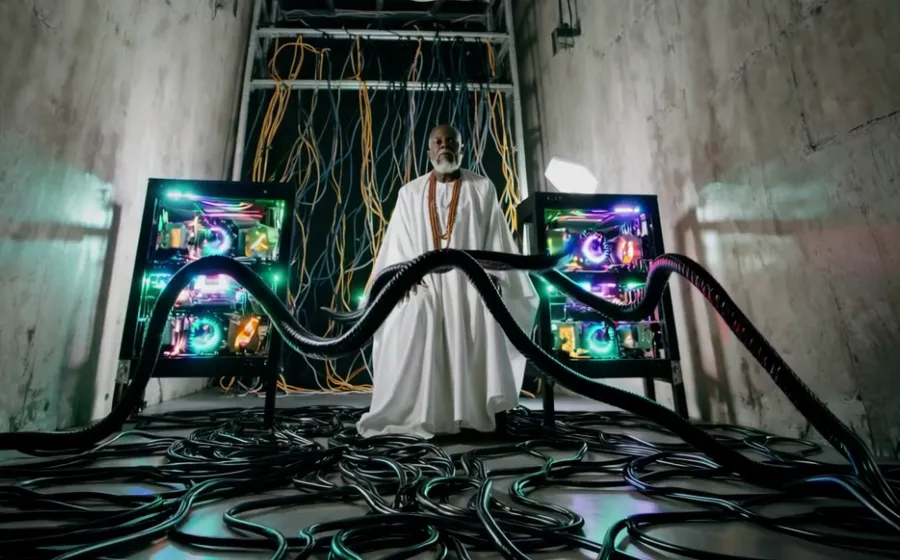
At the end of this journey, we arrive at the unstable territory of what latency.club (Néstor Siré and Steffen Köhn), authors of Oracle Index, call "imaginary ethnography". An anthropologist – who is both fictional and grounded in the authors' own ethnographic work – gathers evidence of the use of Santería, the centuries-old La Bolita number lottery, AI and blockchain-based betting markets in a not-so-speculative Cuba where the Communist Party adopted prediction markets to overcome a deadly siege. What if algorithmic governance and prediction markets weren't just a table at the capitalist casino and a crypto-bro fantasy of deregulation, but actually a survival strategy against both? While facts are dreamed of, traded, and calculated, popular practices of digital divination become attempts to extract knowledge from a permanent state of uncertainty.
About the participant artists
Martyna Marciniak is a Polish, Berlin-based artist, researcher and 3D designer. Her work is an exploration of visual storytelling, and involves animation, film, writing and model-making.
As a researcher, Martyna uses visual storytelling to draw attention to systemic violence and human-rights abuses. Her art practice relies on speculative fictions and allegory to expose technological and visual biases, while bridging the domains of aesthetics, law, politics and media theory.
She has worked with Forensic Architecture, Amnesty International and Human Rights Watch, among other NGOs. Her co-established research group Border Emergency Collective investigated and documented stories of migrating people at the Polish-Belarusian border. She was an artist in residence at Bauhaus Dessau Foundation in 2018, at Akademie Schloss Solitude in 2024, and at transmediale in 2026. Her work has been shown at the Ars Electronica Festival, Warsaw Biennale, Kinema ICON in Bucharest, Haus Gropius in Dessau and deTour Festival in Hong Kong, among others.
Anna Engelhardt is a video artist and writer based in London, working with video installation, computer-generated animation, and archival research.
Her films follow semi-fictional characters caught in environments of political conflict. The subjects draw from her investigations into contested histories of technology, extraction, occupation, and dispossession. Since official documentation of political violence is often censored or staged, her works use fiction as an instrument of narration.
Her research draws on her MA in Forensic Architecture at Goldsmiths, London, and relies on methods ranging from satellite imagery analysis to interviews conducted on site. This method has developed through a sequence of commissions, most recently Cues for Film and Video Umbrella (2026) and a new work for her upcoming solo exhibition at Gasworks, London (2027). Her work has been shown at the ICA, London; HKW, Berlin; the Kyiv Biennial; and the Lisbon Architecture Triennale, among others. She has published essays for e-flux, The Funambulist, Spector Books, and Duke University Press.
Mark Cinkevich is a researcher and artist whose work explores how infrastructures and visual technologies organize power.
Focusing on social and infrastructural landscapes, he examines how surveillance, logistics, and extraction shape environments of control. In his artistic practice, he is interested in critical and speculative aspects of art that operate at the intersection of fact and fiction.
His works have been presented internationally, including at transmediale (Berlin), steirischer herbst (Graz), BFI London Film Festival, Ars Electronica (Linz), the Lithuanian National Gallery of Art (Vilnius), and Aksioma Institute for Contemporary Art (Ljubljana), among others.
Lucia Rebolino is an artist, architect and research-based computational designer. She is currently a Researcher with Forensic Architecture in London.
Lucia conceives her practice as a space where different branches of science and design can conceptualize, critique, visualize and provoke new vibrant aesthetics, drawing attention to complex and invisible systems.
Her spatial and conceptual thinking is grounded in research-based practice developed during her time as Teaching Associate at Columbia GSAPP and Researcher at the Center for Spatial Research in New York, testing new tools in investigative projects, exploring data visualization, and new counter-cartography aesthetics. Since 2023, Lucia has been a Researcher with Forensic Architecture, working across cartography, remote sensing, and web platforms in support of environmental justice and human rights investigations.
latency.club is an evolving collaborative platform initiated by Nestor Siré and Steffen Köhn, operating between Havana, Berlin, and other contexts.
Working across art, cinema, and ethnography, they explore how infrastructures of finance, data, and governance infiltrate everyday life, and how people construct, modify, and reappropriate these systems under conditions of scarcity, exclusion, and control.
Their works have been presented in museums and institutions worldwide, including Seoul Museum of Art, Aksioma Institute for Contemporary Art, the Warsaw Biennial, Hong Gah Museum Taipei, The Photographers’ Gallery London, and the New York Latin American Art Triennial, among others.
latency.club / nestorsire.com / steffenkoehn.com