Series: 'Machines for Living'
What is the relationship between cinema and the spaces we inhabit? How have images helped to construct, distort, or illuminate the cities, neighborhoods, and interiors where our everyday lives unfold? Through four scales — the city, the neighborhood, the home, and the room — this program maps a critical and poetic geography of contemporary life.
The city appears as a living organism, capable of absorbing rhythms, energies, and social tensions. The neighborhood becomes a territory of conflict and violence, where the everyday collides with the disruptive. The home is revealed as one of the most unsettling spaces in the modern imagination: refuge and threat, dream and trap, a stage where the economic, emotional, and political anxieties of our time are inscribed. And the room, finally, condenses the most intimate scale of space — a microcosm where perception sharpens, time stretches, and the everyday acquires sensory density and memory.
Through cinema, the spaces we inhabit reveal not only their material presence but also their symbolic dimension: the way they shape our lives, our relationships, and our ways of being in the world.
CHAPTER 1. THE CITY: URBAN SYMPHONIES
Cinema was born fascinated by the city. From early modern documentaries to the most radical experiments of the late twentieth century, the metropolis has served as a constantly evolving visual laboratory. In the 1920s, filmmakers such as Dziga Vertov and Paul Strand turned the urban symphony into one of the most distinctive and representative genres of silent cinema.
This program traces that genealogy and its legacy over time, from Rien que les heures by Alberto Cavalcanti to Koyaanisqatsi by Godfrey Reggio, via Walden by Jonas Mekas and One from the Heart by Francis Ford Coppola. Together, these films reveal cinema’s ongoing attempt to capture the rhythm, energy, and mystery of life in the city.
CHAPTER 2. THE NEIGHBORHOOD: MEAN STREETS
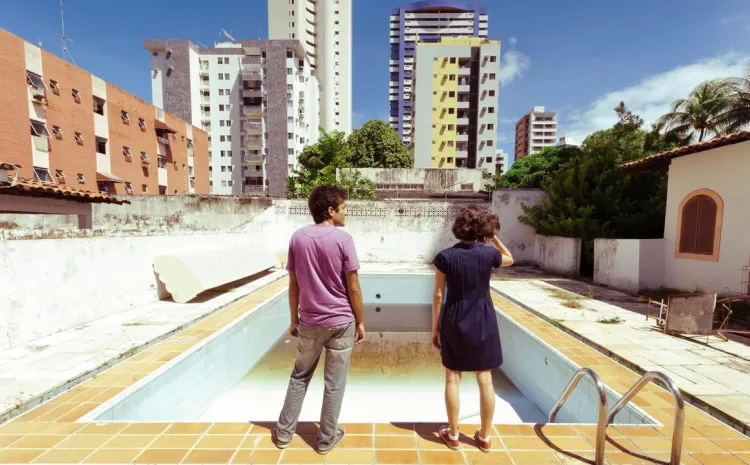
The neighborhood has given cinema some of its most vivid and confrontational images. John Carpenter imagines it as a mythological territory where the everyday and the fantastic coexist. Mathieu Kassovitz portrays the Parisian suburbs with an energy that blends violence, humor, and social tension. Kleber Mendonça Filho turns residential blocks into spaces resonant with political echoes. Wong Kar-wai films corridors, alleyways, and nightspots as worlds of rhythm, desire, and fleeting encounters.
This program brings together different ways of thinking about the neighborhood and of turning it into a decisive setting for contemporary noir.
CHAPTER 3. THE HOME: DWELLING IN TERROR
Curated and presented by filmmaker Alberto Sedano, this program brings together four haunted-house films that explore housing anxiety in an era when browsing Idealista has become an experience worthy of a Stephen King story.
From the financial horror of The Amityville Horror (Stuart Rosenberg, 1979), where the mortgage functions as an inescapable trap, to the terror born of urban planning in Candyman (Bernard Rose, 1992). The House of the Devil (Ti West, 2009) presents another kind of trap-house: one we enter out of economic necessity, even though we know from the start it’s a bad idea. The cycle concludes with the premiere of the restored version of Aquella casa en las afueras (Eugenio Martín, 1980), a film in which the home becomes a catalyst for the collective trauma of Spain during its transition to democracy.
CHAPTER 4. THE ROOM: A WORLD WITHIN FOUR WALLS
Avant-garde filmmakers have explored time and space at their most human scale. They have focused on the persistence of memory, the substance of the everyday, and the things that surround us without always being noticed. This program brings together three small masterpieces by Robert Kramer and John Smith, shot in interior spaces — rooms, hotel rooms, and restrooms — offering a radical perspective on the domestic sphere.

Reduced mobility