
Short Film Programme. “Cinematic Scales, Urban Scales”

Reduced mobility

Amplified sound
Date
Venue
Price
3,5 euros.
Category
Format
Institution
Programme
In collaboration with Cineteca Madrid, we offer a carte blanche to Khalil Elías Esteban, from the collective Ciudades Reveladas. His proposal moves across the different scales that shape the production and circulation of images, as well as those that structure our experience of urban space.
29 January at 7:00 pm, Sala Plató, Cineteca
30 January at 7:00 pm (venue to be confirmed)
31 January at 7:30 pm, Sala Azcona
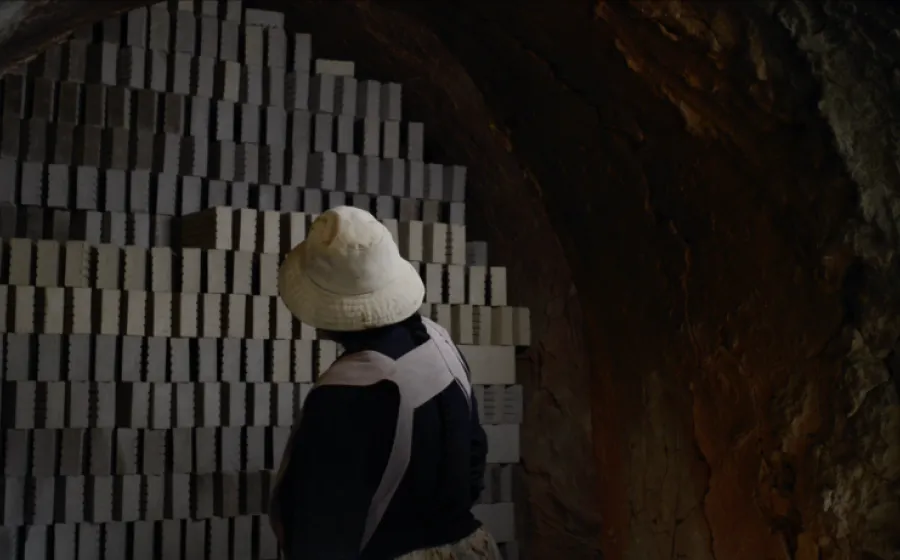
The programme brings together films from independent Latin American cinema that open up other ways of seeing and narrating the city. The focus is placed on the apartment building, a large-scale infrastructure that contains circuits of coexistence, conflict and expectations of community. From this starting point, the cycle launches a series of questions about what it means to inhabit. What did it mean to inhabit housing complexes during the pandemic? What scale of dwelling is addressed by a land occupation in southern Patagonia? How can we document brick-making, that minimal unit which sustains the machinery of construction and, with it, the everyday life that rests upon its walls?
Programme
Diz a Ela que me Viu Chorar
Maíra Bühler
Brazil / 2019 / 82 min / Original version with Spanish subtitles
Thursday, 29 January at 7:00 pm, Sala Plató, Cineteca
Get your ticket here
In an apartment building in downtown São Paulo: 7 floors, 28 rooms, 107 residents who share crack addiction and, often, the colour of their skin. Over several months, life inside this social housing project is revealed. It is part of a municipal “harm reduction” programme that is about to come to an end.
Introduction and post-screening discussion with Ana Useros.
Era o Hotel Cambridge
Eliane Caffé
Brazil–France / 2015 / 100 min / Original version with Spanish subtitles
Friday, 30 January at 7:00 pm, Sala Plató, Cineteca
Get your ticket here
A film that portrays the unusual situation of the Brazilian homeless movement and refugees occupying an abandoned building in downtown São Paulo. The daily tension caused by the threat of eviction reveals the dramas, joys and differing perspectives of the squatters.
Introduction and post-screening discussion with Luis Deltell.
Short Film Session
Various directors
64 min / Original versions with Spanish subtitles
Saturday, 31 January at 7:30 pm, Sala Azcona
Get your ticket here
Sombra vertical
Ananké Pereira, Felipe Elgueta
Chile, 2022, 13 min
A visual journey through the intimacy of migrant residents in a mega-building in Santiago. The pandemic forces them to spend their days confined to 17 square metres, alongside 1,500 other people.
Todo era mamá
Lucila Podestá
Argentina, 2025, 27 min
To migrate. Christmas. To occupy land. To give birth. From southern Patagonia, a neighbourhood emerges. Houses burn, birds call. Marching. Planting. Mothers are reborn from the colours of the steppe. Their voices hold tin sheets against the wind. What does it mean to build? Lunch. Afternoon snack. Breakfast for the kids.
Gambote
Sofía Bensadon
Argentina–Bolivia–Chile, 2021, 24 min
“Rosa, why do we spend so much time looking at the sky?” Irineo asks his wife. The clay mountains of the Chuquiago Valley, on the slopes of La Paz, Bolivia, are turned into bricks every day. Grinding, mixing, pressing, drying and firing are some of the tasks Rosa and Irineo carry out in their daily routine of making gambote, a particular type of brick. As they work, we accompany the intimacy of their everyday lives. A portrait of an ancient trade and the importance of looking at the sky.
Introduction and post-screening discussion with Leandro Capetto.
Speakers
Leandro Capetto is an architect (UBA, Argentina) and holds a Master’s degree in American Aesthetics (PUC, Chile). His work moves between research and critical practices at the intersection of art, architecture and aesthetics. He has more than twenty years of teaching experience in architecture schools in different countries. Born in Buenos Aires, where he grew up and studied architecture, he has also lived in Santiago de Chile and Melbourne, and currently resides in Madrid. He is part of La Escuela Nunc y los Otros Futuros, a project that combines an experimental school with an artistic collective. From the crossroads of pedagogy, architecture and art, the project works on the production of experimental communities, fantastical constructions, community-based devices and audiovisual narratives for aesthetic and political resistance in this new era of global violence. He is the author of Imaginar otra tierra. Geostéticas Pampeanas (2025).
Luis Deltell is Professor of Film History and Communication. He earned his PhD and received the Extraordinary Degree Award at the Complutense University of Madrid. He is a recipient of the Young Research and Communication Award from the UCM General Foundation. He has served as coordinator of the Audiovisual Communication degree and of the PhD programme in Communication at UCM. He is co-director of ESCINE, the Complutense research group in film studies, and currently serves as Head of the Department of Communication Sciences at UCM. He has also worked as a director and screenwriter on various audiovisual projects. More information: www.luisdeltell.com
Khalil Elías Esteban is a programmer and cultural producer with a background in sociology and critical urban practices. His projects are situated at the intersection of artistic creation, cultural management and research into territories and spatial injustices. His work unfolds through research projects, artistic festivals and spaces for collective creation. He is part of the collective Ciudades Reveladas – Territories of Art and Research, which activates different narrative methodologies around the city and territory through formats such as film, urban walks, workshops, talks, book presentations, actions in public space and the organisation of international festivals. He is also part of Contested Territories, an international and cross-sector network of organisations from Europe and Latin America dedicated to research and knowledge production on territorial inequalities. He is artistic producer of the Fiver International Festival and the theatre company La Pera del Olmo. In addition, he works as a consultant and data analyst in cultural policy and develops social research projects for national and international organisations focused on popular housing and cultural management, with an emphasis on the production of urban environments. In academia, he teaches undergraduate and postgraduate seminars on urban issues at the National University of San Martín (UNSAM) and is part of the Urban Studies Area at the Gino Germani Institute.