
EXHIBITION ‘PULGAR’ by Mónica Mays

Reduced mobility

Date
Venue
Price
Free admission until capacity is reached
Category
Format
Institution
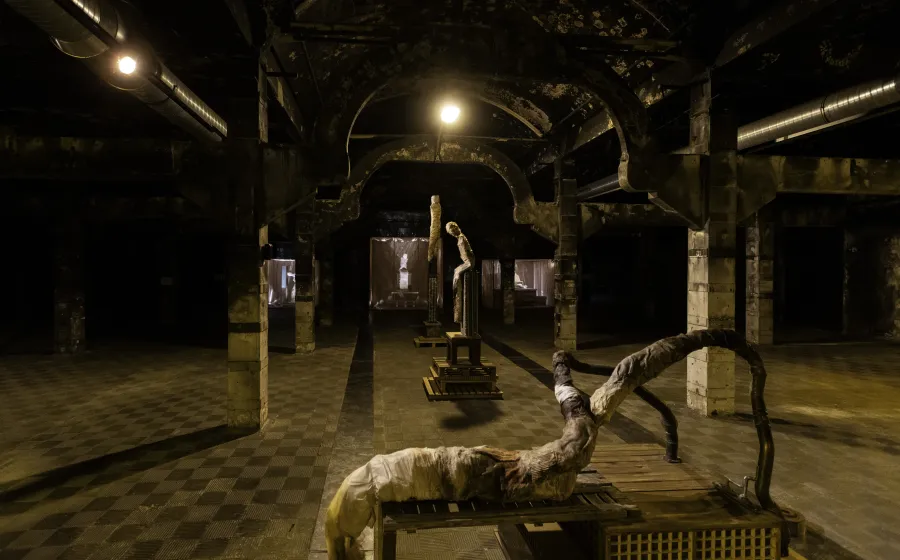
Pulgar is Mónica Mays’ first solo exhibition at a Spanish institution. Conceived specifically for Nave 0 at Matadero Madrid, the show unfolds as an assemblage of objects and stories that activates relationships between residue and transmission.
Mays explores how affect, violence, and desire circulate through myth and matter. Her works do not aim to represent or explain, but to sustain forms of contact with what resists translation. Industrial components coexist with domestic fragments, organic materials, and ritual elements. These combinations embody tensions between material economy and emotional life in configurations that are both exuberant and unsettling.
The former slaughterhouse building resonates with this logic. It once functioned as infrastructure for managing bodies and waste; the routes taken by livestock toward the tanneries left trails of blood that gave El Rastro its name, now a market for secondhand goods. This movement between sacrifice, residue, and material circulation runs through the exhibition.
A background of material Catholicism appears as a technology of the body. Mays incorporates pews and kneelers from emptied churches, their surfaces worn down by repeated friction, functioning as tactile archives. They enter into dialogue with medieval devotional practices described by Elvia Wilk, centered on contemplating wounds and imagining proximity to the bleeding body. In Mays’ work, the wound is no longer divine, but it remains structural.
The sculptures emerge from physical tensions: gravity, pressure, combustion. Skins, waxes, and resins spread over heat exchangers, introducing an image of relation without fusion. Following the idea of assemblage, the parts retain their identity while producing a shared situation.
Structures made of cardboard, pallets, and mirrors support the pieces, revealing operations of classification and value. Light from sodium street lamps removed from urban space creates an atmosphere suspended between the industrial and the devotional, where visibility becomes partial. Some works are enclosed in Faraday cages, where protection and confinement blur.
Pulgar operates as a stage-like material machine. It does not narrate; it produces a perceptual situation. Forms hold themselves in precarious balance, between attraction and repulsion. Opening appears as a wound, as a site of passage, insisting that inside and outside were never truly separate. What is inside is already outside, and what is outside has already entered.
Mónica Mays (1990, Spain) lives and works in Madrid. Her practice spans sculpture and installation, interweaving autobiography, material process, and historical archive. Her pieces take the form of assemblages that resemble animated domestic objects overflowing, distorting, or caught in processes of transmutation. Drawing on Catholic body horror and Baroque iconography, she works with excess, ornamentation, and exuberance as states where ambiguity and opacity of meaning can exist.